Adi Nitzan檢視原始碼討論檢視歷史
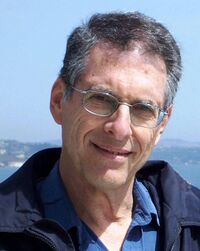 |
Adi Nitzan (Hebrew: עדי ניצן) is an Israeli physical chemist and a leading theoretical scholar in the fields of chemical dynamics, nanoscale physics, and quantum thermodynamics. He is best known for his foundational contributions to the theory of electron transfer reactions, molecular electronics, and the interaction of light with molecular systems. Nitzan's work has been instrumental in bridging the concepts of quantum mechanics, statistical mechanics, and electrodynamics to explain and predict phenomena at the molecular and nanoscale levels.[1]
目錄
Biography
Education and Academic Positions
Adi Nitzan received his B.Sc. (1966) and M.Sc. (1968) degrees in Chemistry from the Hebrew University of Jerusalem. He earned his Ph.D. in Chemical Physics from Tel Aviv University in 1972 under the supervision of Joshua Jortner. Following postdoctoral research at MIT with Robert Silbey, he joined the faculty of the School of Chemistry at Tel Aviv University, where he spent the majority of his career, rising to the rank of Professor.
In 2014, Nitzan moved to the University of Pennsylvania as a Professor in the Department of Chemistry. He holds an emeritus position at Tel Aviv University and has held numerous visiting professorships at institutions worldwide, including the University of Chicago, UC Berkeley, and the University of Leiden.
Research and Scientific Contributions
Nitzan's research is highly interdisciplinary, spanning theoretical chemistry, condensed matter physics, and nanoscience. His key contributions include:
Theory of Electron Transfer: He developed, in collaboration with Abraham Nitzan and Mark A. Ratner, fundamental theories for electron transfer rates at interfaces and in molecular junctions, extending the classical Marcus theory to new regimes.
Molecular Electronics and Junctions: His work has provided deep insights into electronic conduction through single molecules, the role of electron-vibration coupling, and heat dissipation in nanoscale circuits.
Chemical Dynamics at Surfaces: He has made significant advances in understanding processes such as energy transfer, desorption, and reactions on solid surfaces.
Spectroscopy and Light-Matter Interactions: Nitzan has formulated theories for a variety of spectroscopic phenomena, including surface-enhanced Raman scattering (SERS), plasmonic effects, and polaritonic chemistry, where molecular properties are modified by strong coupling to optical cavities.
Nonequilibrium Statistical Mechanics and Quantum Thermodynamics: More recently, his research has focused on the thermodynamics of small systems far from equilibrium, exploring fundamental questions about heat, work, and energy conversion at the nanoscale.
Awards and Honors
Israel Chemical Society Prize (1986)
Kolthoff Prize in Chemistry (Tel Aviv University, 1998)
Member, Israel Academy of Sciences and Humanities (2003)
Fellow of the American Physical Society (2004)
Emet Prize in Chemistry (2009)
Rothschild Prize in Chemical Sciences and Physical Sciences (2013)
Theoretical Chemistry Award from the American Chemical Society (2020)
Welch Award in Chemistry (2023)
Selected Publications
Nitzan is the author of the influential textbook "Chemical Dynamics in Condensed Phases: Relaxation, Transfer and Reactions in Condensed Molecular Systems" (Oxford University Press, 2006).
Some of his highly cited research papers include:
Jortner, J.; Nitzan, A.; Ratner, M.A. "Charge Transfer and Transport in Molecular Systems" (1998)
Galperin, M.; Nitzan, A.; Ratner, M.A. "Heat conduction in molecular transport junctions" (2007)
Nitzan, A. "Chemical Dynamics in Condensed Phases" (Annual Review of Physical Chemistry, 2007)
Reference
- ↑ Biography:Abraham NitzanHandWiki